Indwelling of Holy Spirit – June 2026
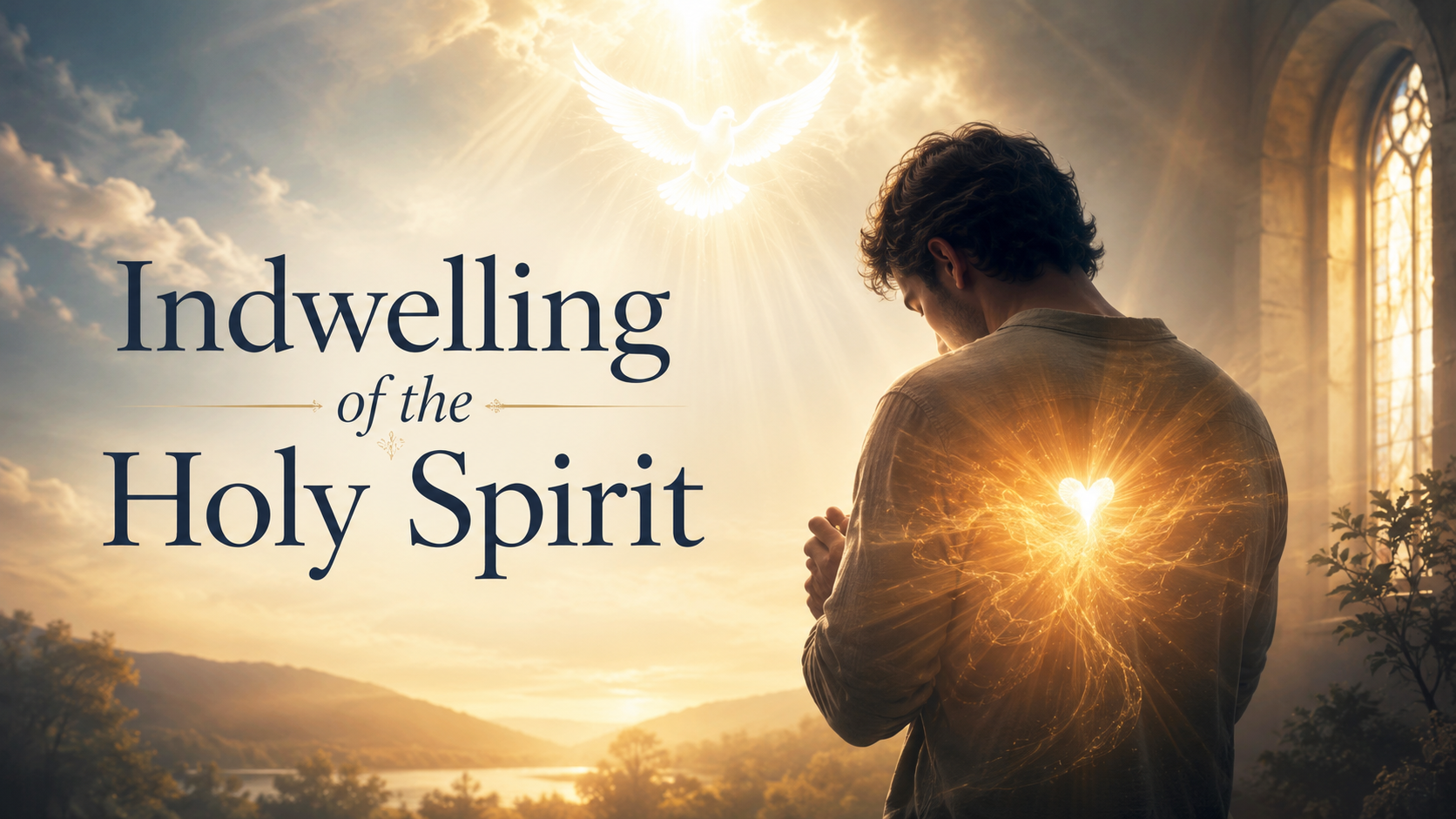
“And I will pray the Father, and He will give you another Helper, that He may abide with you forever — the Spirit of truth, whom the world cannot receive, because it neither sees Him nor knows Him; but you know Him, for He dwells with you and will be in you.” (John 14:16–17, NKJV)
“Jesus answered and said to him, ‘If anyone loves Me, he will keep My word; and My Father will love him, and We will come to him and make Our home with him.’” (John 14:23, NKJV)
Dear brothers and sisters in Christ, our hearts are deceitful. Incurvatus in se is a Latin phrase meaning “turned, or curved, in on oneself.” Its theological roots reach back to Augustine and were sharpened by Martin Luther in the sixteenth century. Luther writes that “Scripture describes man as so curved in upon himself that he uses not only physical but even spiritual goods for his own purposes and in all things seeks only himself” (Lectures on Romans, in Luther’s Works, vol. 25, p. 345).
John Calvin picks up the same thread:
“So long as we do not look beyond the earth, we are quite pleased with our own righteousness, wisdom, and virtue; we address ourselves in the most flattering terms, and seem only less than demigods. But should we once begin to raise our thoughts to God, and reflect what kind of Being he is, and how absolute the perfection of that righteousness, and wisdom, and virtue, to which, as a standard, we are bound to be conformed, what formerly delighted us by its false show of righteousness will become polluted with the greatest iniquity; what strangely imposed upon us under the name of wisdom will disgust by its extreme folly; and what presented the appearance of virtuous energy will be condemned as the most miserable impotence.” (Institutes of the Christian Religion, 1.1.2)
Even René Descartes, the French philosopher, opens his Meditations on First Philosophy by imagining an evil genius “of utmost power and cunning” who “has employed all his energies in order to deceive me” — a hypothesis he uses to doubt every received certainty (Meditations, I). The Apostle Paul confesses the same evil within himself in Romans 7:
“Now if I do what I will not to do, it is no longer I who do it, but sin that dwells in me. I find then a law, that evil is present with me, the one who wills to do good. For I delight in the law of God according to the inward man. But I see another law in my members, warring against the law of my mind, and bringing me into captivity to the law of sin which is in my members.” (Romans 7:20–23, NKJV)
Therefore, my brothers and sisters, there is a contradiction, a war between flesh and Spirit. There can be no middle ground. There is no win-win situation. There can be no compromise between what the flesh wants and what the Spirit wants. “For the flesh lusts against the Spirit, and the Spirit against the flesh; and these are contrary to one another, so that you do not do the things that you wish” (Galatians 5:17, NKJV).
Consequently, you are not what you desire. You are not what your flesh craves. You are not your ingrained evil habits. In Jesus, you are no longer identified by your sin. Sin degrades and weakens us, and labels us inwardly — an alcoholic, a smoker, an addict, a criminal. But when we accept Jesus as our Lord, and turn and submit to Him, He calls us His beloved. There is an epidemic of identity; we do not know who we are. Yet we are not so lost that Christ cannot find us. He calls you His own.
If you, then, my dear reader, feel lost, without identity, and are known by a degrading nickname, look at Christ. He has loved you from the beginning.
Therefore, “there is now no condemnation” (Romans 8:1, NKJV) for those who call on Christ Jesus as Lord, because they no longer belong to themselves. “Or do you not know that… you are not your own? For you were bought at a price; therefore glorify God in your body and in your spirit, which are God’s” (1 Corinthians 6:19–20, NKJV).
What does it mean, personally, that I am not my own? It means that my eyes do not belong to me, my intellect does not belong to me, my hands and my body do not belong to me — they belong to Christ. Hence Paul could write: “I have been crucified with Christ; it is no longer I who live, but Christ lives in me; and the life which I now live in the flesh I live by faith in the Son of God, who loved me and gave Himself for me” (Galatians 2:20, NKJV). The “I” — the ego — no longer lives. Christ lives in its place.
This is what is called as “Born of the Spirit” The Holy Spirit is the One who quickens — “of His own will He brought us forth by the word of truth” (James 1:18, NKJV) — and the new affections are the fruit of His prior, sovereign work in us.
It is from this new birth, then, that the indwelling Christ produces in us new desires. Thomas Chalmers, in his sermon The Expulsive Power of a New Affection, writes:
“There are two ways in which a practical moralist may attempt to displace from the human heart its love for the world — either by a demonstration of the world’s vanity, so that the heart shall be prevailed upon simply to withdraw its regards from an object that is not worthy of it; or, by setting forth another object, even God, as more worthy of its attachment, so that the heart shall be prevailed upon not to resign an old affection, which shall have nothing to succeed it, but to exchange an old affection for a new one. From the constitution of our nature, the former method is altogether incompetent and ineffectual, and the latter method will alone suffice for the rescue and recovery of the heart from the wrong affection that domineers over it.”
Habits are replaced by habits; desires, by superior desires. Christ becomes infinitely precious. All things pale in comparison. As Paul writes, everything else “I count as rubbish, that I may gain Christ” (Philippians 3:8, NKJV).
We are transformed and strengthened. We become true and Christ-like. A desire to resist the devil is formed. The desire for holiness increases. And a question arises: “What shall I render to the LORD for all His benefits toward me?” (Psalm 116:12, NKJV). These are not the conditions of the new birth; they are its visible fruits — evidence that the Spirit who hovered over the waters at creation has now brooded over our dead hearts and made them live.
The question:
Dear reader, if the Spirit of God indeed dwells in you, what is He asking of you? Is it repentance? Is it breaking from a specific addiction? Is it forgiving a person who has wronged you? Is it a step of faith toward a calling? “See that you do not refuse Him who speaks” (Hebrews 12:25, NKJV).
If Christ could forgive you who have betrayed Him a thousand times over — if, while you were yet His enemy (Romans 5:10), He extended salvation as a free gift and redemption through His shed blood — then you have no reason not to forgive those who have wronged you. “Be kind to one another, tenderhearted, forgiving one another, just as God in Christ forgave you” (Ephesians 4:32, NKJV).
We forgive because He first forgave us.
As we end this meditation, I invite you to stop, pause, and enter His presence. He wants to speak to you.

 God's Love Missions